Cost & Usage Analytics
Answer What AI Costs - Per Developer, Per Team, Per Model
Model-aware pricing turns raw token counts into per-team chargeback, budget thresholds, and adoption metrics finance can actually use.
The Problem
The AI Bill Has No Owner
AI spend arrives as a handful of provider invoices with no attribution: one line for the org, nothing per team, nothing per developer, nothing per repository. Finance cannot allocate it, engineering leaders cannot defend it, and nobody can tell an expensive habit from an expensive model.
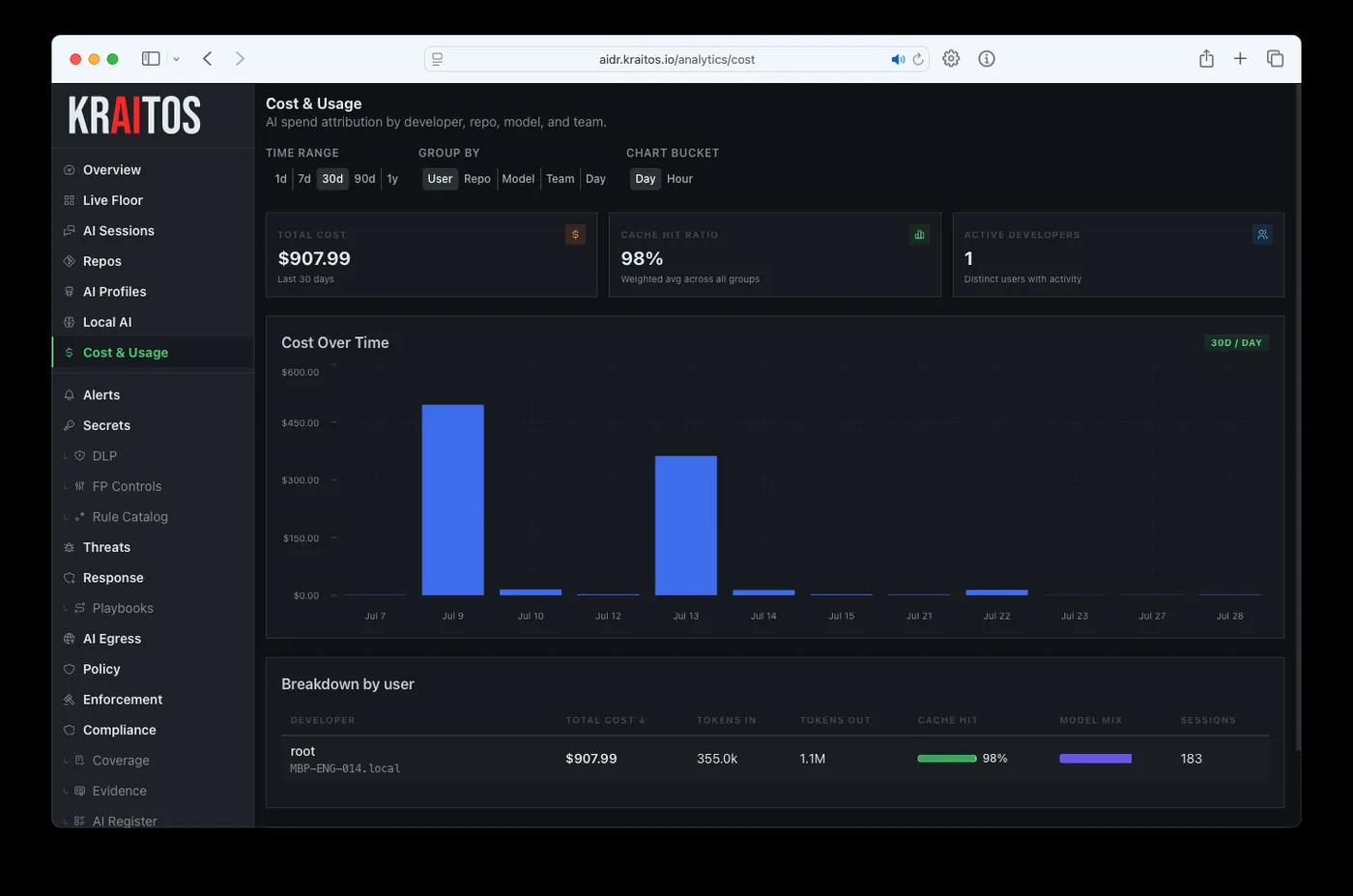
Because Kraitos AIDR reconstructs sessions turn by turn, cost attribution comes from the same telemetry as everything else - input, output, cache read, and cache write tokens, priced by model.
How It Works
From Tokens to Chargeback
- Per-developer, per-team, and per-model token and cost tracking with 30-day trends
- Model-aware pricing across model families - Opus, Sonnet, Haiku, GPT-4 class, and others
- Budget alerts and cost-threshold policies that fire before the invoice does
- Chargeback-ready exports for finance
- Adoption metrics: which teams use which tools, session frequency, and tool mix over time
Cost dimensions
| Dimension | Detail |
|---|---|
| Token types | Input, output, cache read, cache write - counted per turn |
| Attribution | User, team, device, repository, model, session |
| Policy hooks | Budget and usage thresholds enforced by the policy engine |
| Trends | 30-day rolling windows per user, team, and model |
| Export | CSV for finance and chargeback workflows |
What You See
Spend by Team and Model
See Kraitos AIDR in Action
Deploy in 60 seconds. Get answers in 24 hours. Stop guessing what your AI-augmented organization is doing.
[email protected]kraitos.io