AI Detection & Response for your entire workforce
Detect and secure the AI apps your workforce and developers actually use. Identify and stop Shadow AI. Monitor what happens inside each AI session. Catch secrets and sensitive data in prompts and redact them without stopping work. Track spend, enforce compliance, and get work done.
Kraitos AIDR in 60 Seconds
See every AI tool in your fleet, find the secrets in AI sessions, and prove compliance, all in one minute.
AI Tools Are Your Biggest Blind Spot
AI coding agents execute shell commands, access files, install packages, and write production code - with virtually no oversight.
- No inventory. Developers install Claude Code, Cursor, Copilot, Windsurf, and a dozen others on their own. IT doesn't know what's running.
- No data controls. API keys, credentials, and proprietary code leak into AI prompts with no detection or prevention.
- No cost visibility. Finance asks "what are we paying for AI APIs?" and nobody can answer.
- No audit trail. When an AI agent deletes a production file or installs a vulnerable package, there's no record.
- No compliance evidence. SOC 2, ISO 27001, and NIST auditors are asking about AI governance - and most teams have no answer.
One Agent. Four Pillars.
Kraitos AIDR deploys as a single lightweight agent - under 50 MB memory, less than 1% CPU - covering AI governance, data protection, threat detection, and asset management in one install.
Monitor
Real-time visibility into every AI tool, every session, every token, every dollar across your fleet.
- AI Tool Discovery
- Session Intelligence
- Cost & Usage Analytics
- Live Floor
- Data Egress
- Local AI Detection
Protect
Enforce policies, detect secrets, scan for threats, and produce audit-ready compliance evidence.
- Policy Engine
- Secret & DLP Detection
- Threat Detection
- Compliance Automation
- AI Profiles
Respond
Automated and human-gated response actions with SOAR-lite playbooks for AI-related incidents.
- Isolate / Kill / Expire
- Playbook Builder
- Quarantine Manager
- Approval Workflows
Assets
Complete endpoint inventory: hardware, software, browser extensions, and AI tool configurations.
- Device Inventory
- Software & Hardware
- Browser Extensions
- Repository Discovery
- Dependency Audit

Find Every AI Tool on Every Endpoint - Known or Unknown
Shadow AI is the number one risk CISOs cite when it comes to AI adoption. Developers install tools without IT approval, connect to unauthorized LLM APIs, and run local inference servers that never touch the corporate network.
Kraitos AIDR's five-layer detection architecture closes this blind spot. It identifies 48 AI tools by name, monitors network connections to 115 AI service endpoints across 69 providers, and uses behavioral heuristics to catch tools that don't have signatures yet - including custom scripts that call LLM APIs directly.
| Discovery | Filesystem scanning for config directories, VS Code and JetBrains extensions, and process names - 48 AI tools detected by name |
| Network | Connection monitoring identifies 115 AI service endpoints across 69 providers, plus 7 local inference servers, by destination |
| Behavioral | Behavioral heuristics recognize how AI tools act - catching unknown and custom tools no signature list has heard of |
| Telemetry | Deep session telemetry for Claude Code - full conversation replay, token tracking, MCP visibility |
| Dependency | Dependency monitoring across 9 package formats, with known vulnerabilities flagged automatically |
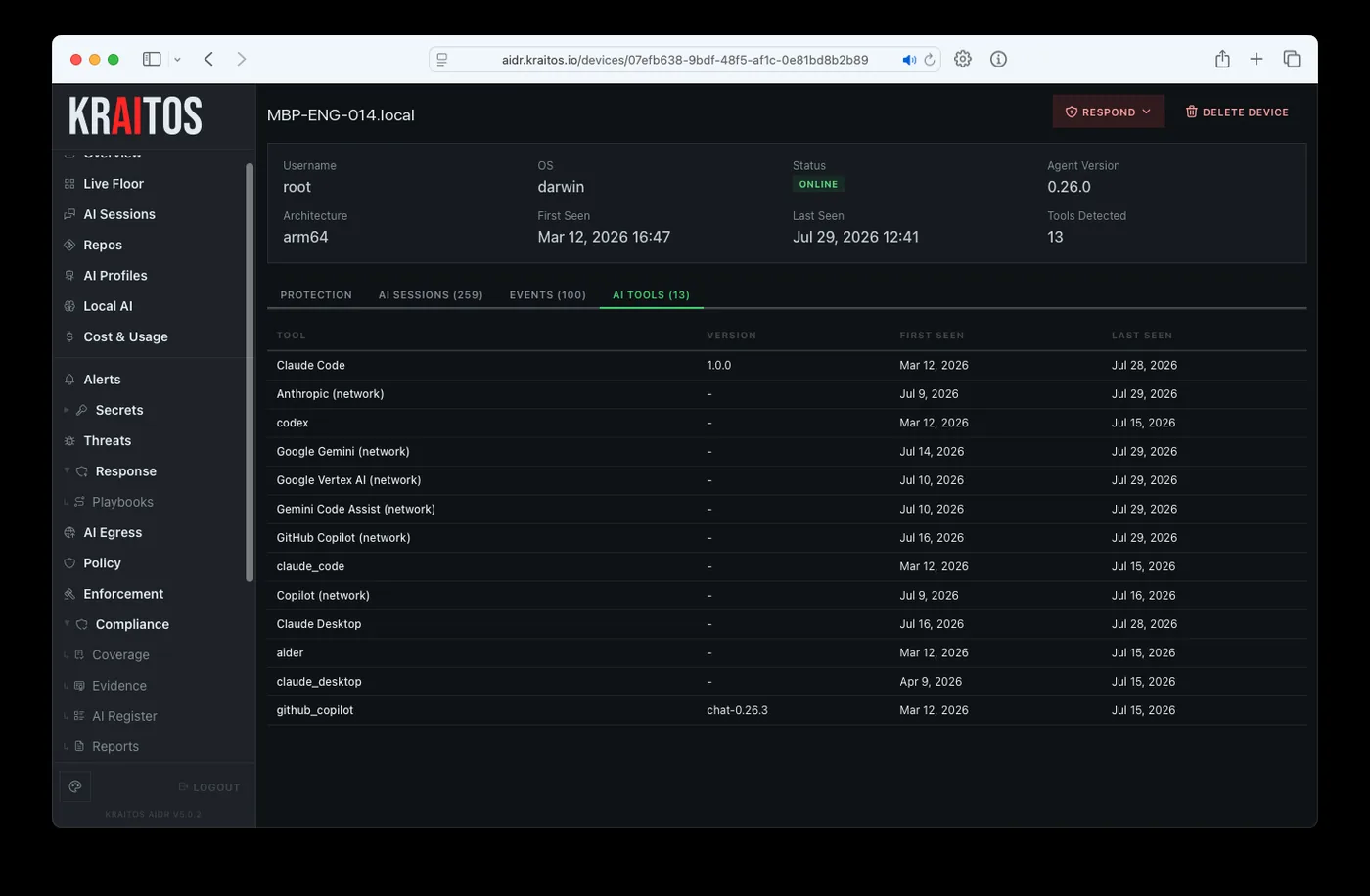
- Supported Tools
- Claude Code, Codex (OpenAI CLI), Aider, OpenCode, OpenHands, Devin, Factory Droid, Amp (Sourcegraph), Goose (Block), Crush (Charm), Qwen Code, Kilo Code, Roo Code, Cline, OpenClaw, Kiro, Google Antigravity, Warp, Cursor, Windsurf, Codeium, GitHub Copilot, Cody (Sourcegraph), Continue, Tabby, Tabnine, Supermaven, Amazon Q Developer, Gemini Code Assist, Zed, Augment Code, Blackbox AI, Pieces for Developers, Trae, Qodo Gen, JetBrains AI Assistant, JetBrains Junie, Claude Desktop, ChatGPT Desktop, Microsoft Copilot, Grok (xAI), Ollama, LM Studio, Jan.ai, GPT4All, Msty, AnythingLLM, Open WebUI
- Local Inference
- Ollama, LM Studio, Jan.ai, GPT4All, llama.cpp, text-generation-webui, vLLM
- Cloud APIs
- 115 AI service endpoints across 69 providers, including OpenAI, Anthropic, Google, AWS Bedrock, Azure OpenAI, Groq, Mistral, Cohere, and DeepSeek
- WSL Support
- Full cross-boundary detection for Windows Subsystem for Linux environments
Full Conversation Replay - Every Prompt, Tool Call, and File Access
Kraitos AIDR reconstructs complete Claude Code sessions with every turn: user prompts, assistant responses, tool invocations, file reads and writes, shell commands executed, and MCP server connections - all with per-turn token counts and cost.
When an incident occurs - a leaked credential, a deleted production file, a malicious package install - you have the full forensic record. Not just “something happened” but exactly what the AI did, what the developer asked, and what changed.
- Complete conversation timeline - user prompts, assistant responses, and every tool call in sequence
- File operations tracked - every read, write, and edit performed by the agent, with path and context
- Shell command logging - full command text, working directory, execution context
- MCP server connections - which external tool servers the AI reached and what it sent
- Subagent relationships - parent/child session mapping when the AI spawns background agents
- Cost attribution - per-turn token counts (input, output, cache read, cache write) with model-aware pricing

Real-Time DLP for AI Conversations - Detect, Redact, Allow
AI coding agents routinely encounter credentials in codebases - API keys in config files, database passwords in environment variables, private keys in deployment scripts. Without protection, these secrets end up in prompts sent to cloud LLM providers, creating credential exposure events that can trigger breach notification requirements.
Kraitos AIDR scans AI conversations in real time with 37+ detection patterns across five data categories. When a secret is detected, the platform can redact the sensitive content directly from the session file while allowing the conversation to continue - protecting the credential without disrupting the developer's workflow.
- 37+ detection patterns across cloud providers, source control, AI providers, and payments
- Infrastructure credentials - private keys, JWTs, database connection strings, Redis URIs
- PII and regulated data - SSNs, emails, phone numbers, medical record patterns, card numbers
- Unknown-format detection - entropy analysis catches high-randomness secrets that match no known pattern
- Context-aware attribution - was it a user prompt, an assistant response, or a tool call output?
- Live credential verification - probe the provider to learn whether the leak is live, revoked, or unknown
- Tracked rotation lifecycle - mint a replacement, revoke the leak, and re-verify that it is dead


Know Where Your Data Goes - Sanctioned AI, Shadow AI, and Everything Between
Every AI tool on every endpoint is making outbound connections - to cloud LLM APIs, to MCP servers, to cloud storage, to destinations your security team has never evaluated. Kraitos AIDR classifies every outbound AI-related connection and gives you the controls to set data boundary policies and get alerted on them.
The egress console categorizes every destination as sanctioned, shadow, cloud storage, unknown, or not allowed - and lets you reclassify it. Promote a destination to sanctioned, mark it as not allowed, or route the decision through the policy engine for automated alerting.

Everything Else in the Same Agent
No second install, no bolt-on console, no per-module pricing. Every capability below ships in the agent you already deployed.
AI Profiles
Group Policy for AI. Define CLAUDE.md, .cursorrules, Copilot instructions, and MCP allowlists centrally, then push them to every managed repo on every machine.
- Template library
- Discover & assign
- Drift detection
- Hierarchical merge
Policy Engine
Watch everywhere, or block in Claude Code - rules cover tools, models, data, spend, and dependencies. Policies stream to agents in under a second and evaluate locally in sub-millisecond time.
- Monitor & enforce modes
- 4 scope levels
- 23+ templates
- Audited exceptions
Compliance Automation
53 controls across 7 frameworks, with evidence generated continuously as developers work - not assembled the week before an audit.
- Signed evidence bundles
- Drift detection
- Control attestation
- Auditor export
Endpoint Protection
Seven detection engines ship in the same agent: AI discovery, secret scanning, native malware, YARA, IOC matching, Sigma behavioral, and file integrity monitoring.
- 6.5M+ malware signatures
- MITRE ATT&CK mapping
- Posture checks
- Compliance scoring
Response & Playbooks
Isolate a device, kill a process, or expire a leaked credential - automatically or behind a human approval gate, with a full audit trail on every action.
- Device containment
- SOAR-lite playbooks
- Approval workflows
- Encrypted quarantine
Cost & Usage Analytics
Per-developer, per-team, per-model token and cost tracking with 30-day trends, budget alerts, and chargeback-ready exports for finance.
- Model-aware pricing
- Budget thresholds
- Adoption metrics
- Finance exports
Seven Engines. One Install.
EDR-class protection ships alongside AI governance. Every engine keeps itself current - signatures update automatically, with no restart and no maintenance window - and feeds the unified device compliance score.
| Engine | Function | Method |
|---|---|---|
| AI Tool Discovery | Find every AI coding tool on every endpoint | Filesystem, network, behavioral, and deep telemetry layers |
| Secret Scanner | Detect credentials and sensitive data in AI conversations | 37+ patterns plus entropy analysis for secrets no pattern knows about |
| Native Malware Scanner | Detect malicious binaries and files | 6.5M+ malware signatures, refreshed automatically |
| YARA Scanner | Match files against YARA rules | A yara-x engine with a compiled rule bundle, built into the agent with nothing extra to install |
| IOC Matcher | Match against curated threat intelligence | File, domain, and IP indicators from continuously updated threat feeds |
| Sigma Behavioral | Detect suspicious endpoint behavior | Behavioral rules with full MITRE ATT&CK mapping |
| File Integrity Monitor | Detect modification of critical system files | Tamper baselines with real-time change alerts |
- SOC 2
- ISO 27001
- NIST 800-53
- PCI DSS v4.0.1
- HIPAA
- NIST AI RMF
- EU AI Act
53 controls mapped across seven frameworks, with evidence generated continuously as developers work.
Fast Deployment. Zero Developer Friction.
No infrastructure to manage. No reboot. No developer interaction. The agent runs silently - no popups, no configuration screens, no prompts.
- Step 01
Create an enrollment code
Generate a short enrollment code in the dashboard. Codes carry their own constraints: OS restrictions, CIDR allowlists, team auto-assignment, single- or multi-use, and an expiry window.
- Step 02
Install the agent
Download the signed Windows MSI or the macOS and Linux installer from the dashboard and run it with the code, or push it through your existing endpoint management tooling. No reboot, no imaging, no developer interaction.
- Step 03
Devices report instantly
AI tools, sessions, posture, and inventory flow into the dashboard within seconds of the agent starting. A short guided tour on first sign-in walks you through deployment, the Live Floor, AI Sessions, Inventory, and Compliance.
- Memory
- < 50 MB
- CPU
- < 1%
- Platforms
- macOS · Linux · Windows
- Updates
- Automatic
Buy direct, or subscribe through AWS Marketplace and pay on your AWS bill.
Three Markets Each Solve a Third of the Problem
EDR sees malware but not AI. AI security platforms see the model layer but ship no endpoint agent. Compliance automation sees neither. Kraitos AIDR is all three in one agent, on one per-endpoint line item.
AI Governance + Endpoint Security
Full AI session visibility, data loss prevention, and EDR-class endpoint protection in a single agent. No bolt-ons, no integrations, no second install.
- One agent
- Seven detection engines
- Under 50 MB
- No second console
Local-First Policy Enforcement
Policies evaluate on the endpoint in sub-millisecond time - no cloud round-trip, no latency, no single point of failure. Developers do not experience a slowdown.
- Sub-ms evaluation
- Policy push under 1s
- Works offline
- Monitor & enforce modes
Full Conversation Intelligence
Not just prompts - every tool call, file access, shell command, MCP connection, and subagent relationship, with per-turn token counts and cost.
- Session replay
- Shell command log
- MCP destinations
- Cost attribution
AI Profiles - Group Policy for AI
Centrally manage CLAUDE.md, .cursorrules, MCP allowlists, and memory packs across every repo on every machine, with drift detection and reconciliation.
- Template library
- Fleet-wide push
- Drift alerts
- Hierarchical merge
Four Roles, One Platform
Security Leadership
Own the AI attack surface without becoming the team that says no.
- See every AI tool, secret exposure, and threat
- Enforce data boundaries without blocking productivity
- Incident response with full AI activity context
Technology Leadership
Answer what AI costs, who uses it, and whether it is standardized.
- Per-team AI cost tracking for chargeback
- Adoption metrics by team, tool, and model
- Standardize AI tooling across the org
Engineering Leadership
Make AI standards real without policing pull requests.
- Centralized AI Profiles for engineering standards
- New hire onboarding in minutes, not days
- Repo-scoped rules for different risk levels
GRC & Audit
Walk into the audit with AI governance evidence already collected.
- Seven frameworks pre-mapped with control evidence
- Export for auditors
- AI Register for EU AI Act readiness
See Kraitos AIDR in Action
Enroll an endpoint and see which AI tools it runs. Stop guessing what your AI-augmented organization is doing.
[email protected]kraitos.io